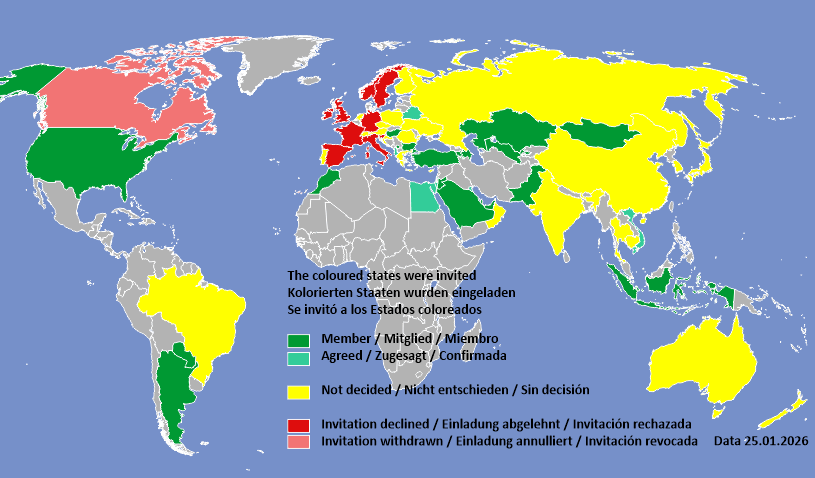
Board of Peace - Donald Trump
The Board of Peace is not a typical international organisation, as Donald
Trump unilaterally dominates it, it is virtually unregulated, and it
deliberately sees itself as a counterpoint to the United Nations. This calls for
a brief introduction.
History of its origins
1. Origins in the Gaza conflict (2023–2025)
- Following the Gaza War in October 2023, international discussions began
on a new administrative and security structure for Gaza.
- Tony Blair first proposed international administration in August 2025.
- Donald Trump presented his own plan in September 2025, which was partially
accepted by Israel and Hamas.
2. UNO-Resolution 2803 (17. November 2025)
The UN Security Council passed Resolution 2803, which: - welcomed the
establishment of the Board of Peace,
- assigned it a role in the reconstruction of the Gaza Strip,
- and authorised a temporary international stabilisation force.
- This resolution was the formal international basis for the project.
3. Political preparation (October 2025 – January 2026)
- On 12 October 2025, after talks with Palestinian representatives, Trump
declared, ‘The war is over’ and announced the rapid formation of the Board.
- In early January 2026, it was announced that Nikolay Mladenov was to be the
Director-General.
- El 14 de enero de 2026 comenzó la fase 2 del Acuerdo de Paz de Gaza, y
Estados Unidos envió las primeras invitaciones a los Estados.
4. Public announcement (15 January 2026)
Trump announced on Truth Social:
- ‘THE BOARD OF PEACE has been formed,’ calling it the ‘largest and most
prestigious board ever.’
- At the same time, he announced that he would soon name the members.
5. International invitations (17–21 January
2026) Numerous heads of state and government received personal
invitations, including:
- Argentina, Turkey, Albania, Canada, Israel, Egypt, Saudi Arabia and
others,
- Some countries accepted immediately, while others responded hesitantly or
declined.
- Canada was later disinvited.
6. Offizielle Gründung in Davos (22. Januar 2026)
Auf dem Weltwirtschaftsforum in Davos fand die Unterzeichnung der
Gründungsurkunde statt.
- Representatives from 19 countries signed the charter.
- Trump personally presided over the ceremony..
-
Israel stayed away because Switzerland had announced that it would have to
execute an ICC arrest warrant against etanyahu.
7. Structure and distribution of power Trump was
enshrined in the charter as chairman for life.
Only he can:
- Invite members,
- Appoint successors,
- Create or dissolve sub-organisations,
- Approve amendments to the charter.
- Countries can only obtain permanent membership by paying US$1 billion.
Pros and cons
|
Criteria |
Arguments in favour |
Arguments – Cons |
|---|
| Basic idea |
Could send a visible political
signal for peace efforts |
Critics see the idea as vague, unclear or politically
motivated |
| Diplomacy |
Opportunity to create alternative
diplomatic channels |
Risk of circumventing or weakening established
diplomatic structures |
| Efficiency |
Could shorten decision-making
processes and enable faster responses |
Risk of lack of transparency and institutional control |
| Personnel
& experience |
Opportunity to involve
experienced negotiators or experts |
Fear that political loyalty would
be more important than professional competence |
|
International impact |
Could be perceived as
a sign of willingness to engage in dialogue |
Other states could view the body
as one-sided or biased |
| Security policy |
Supporters see it as an alternative
to military escalation |
Critics doubt its real effectiveness in complex
conflicts |
| Symbolism |
Can be presented domestically as a
peace initiative |
Risk that it will remain largely symbolic and deliver
few concrete results |
| Flexibility |
Independent body could act more
creatively and unconventionally |
Lack of institutional integration could lead to
conflicts with existing authorities |
| Domestic political
impact |
Supporters see it as leadership
strength and vision |
Critics see it as political branding rather than a
functional instrument |
| Transparency |
Could create clear communication
structures |
Risk of non-transparent decision-making processes and
lack of accountability |
| Costs & resources |
Could be more cost-effective than
military operations |
Critics fear inefficient use of resour-ces without
measurable benefits |
| Legal basis |
Could be designed flexibly |
Uncertainty about responsibilities, mandate and legal
basis |
| Public perception |
Supporters see it as a peace project |
Critics see it as a political tool for image
cultivation |
| Long-term effects |
Could establish new diplomatic
traditions in the long term |
Risk that it will disappear again after changes in
government or remain ineffective |
Wikipedia short informationThe Board of Peace (BoP) is an
United States government-led organization established by Donald Trump
for the stated purpose of promoting peacekeeping around the world. It is
named in United Nations Security Council Resolution 2803 as a body
tasked with overseeing the processes of the Gaza peace plan. The board
was proposed in September 2025 and formally established on the sidelines
of the 56th World Economic Forum in January 2026.
Link:
BoP
Official Web-Site
Founding Resolution of the Board of Peace No. 1 – 22 January 2026
Member States, undecided, invited and rejecting States
| Members and
candidates |
Invited
Not yet decided |
Invitation declined |
|---|
| Argentina |
Australia |
France |
| Armenien |
Austria |
Germany |
| Azerbaijan |
Brazil |
Ireland |
| Bahrain |
Cambodia |
Italy |
| Bulgaria |
China |
Norway |
| Hungary |
Croatia |
Slovenia |
| Indonesia |
Cyprus |
Spain |
| Jordanien |
Czech Republic |
Spanien |
| Jordan |
Finland |
Sweden |
| Kazakhstan |
Greece |
United Kingdom |
| Kosovo |
India |
|
| Mongolia |
Japan |
Dismissed by Trump |
| Morocco |
Netherlands |
Canada |
| Pakistan |
New Zealand |
|
| Paraguay |
Oman |
|
| Qatar |
Poland |
|
| Saudi Arabia |
Portugal |
|
| Turkey |
Romania |
|
| United Arab
Emirates |
Russia |
|
| United States |
Singapore |
|
| Usbekistan |
South Korea |
|
| |
Switzerland |
|
| Absicht Teilnahme
bestätigt |
Thailand |
|
| Albanien |
Ukraine |
|
| Belarus |
Vatikan |
|
| Ägypten |
European Union |
|
| Israel |
|
|
| Kuwait |
|
|
| Vietnam |
|
|
Data: 01/31/2026
|